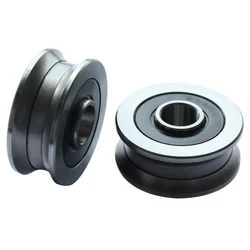
What are the benefits of using self-lubricating or maintenance-free track bearings?
Using self-lubricating or maintenance-free track bearings can offer several significant benefits in terms of convenience, performance, and cost-effectiveness. Let’s explore the advantages of utilizing self-lubricating or maintenance-free track bearings:
- Elimination of External Lubrication: One of the primary advantages of self-lubricating or maintenance-free track bearings is that they eliminate the need for external lubrication. These bearings are pre-lubricated with a solid lubricant or have a built-in lubrication system that provides a continuous supply of lubrication to the bearing surfaces. This eliminates the requirement for manual lubrication or periodic re-lubrication, saving time and effort in maintenance tasks.
- Extended Service Life: Self-lubricating or maintenance-free track bearings are designed to provide long service life. The presence of a solid lubricant or a self-lubricating material within the bearing helps reduce friction, wear, and the risk of surface damage. This results in improved durability and extended service life, reducing the frequency of bearing replacements and downtime for maintenance.
- Reduced Contamination and Cleanliness: External lubricants, such as grease or oil, can attract and accumulate contaminants, such as dust, dirt, or debris. In contrast, self-lubricating or maintenance-free track bearings minimize the risk of contamination since they do not require additional lubricants. This helps maintain a cleaner operating environment and reduces the potential for bearing failure due to contamination-related issues.
- Improved Reliability and Performance: Self-lubricating or maintenance-free track bearings offer consistent and reliable performance throughout their service life. The presence of an effective lubrication system ensures proper lubrication even under demanding operating conditions, such as high temperatures or high loads. This contributes to smoother and more predictable motion, reduced friction, and enhanced overall performance of the machinery or equipment.
- Cost Savings: While self-lubricating or maintenance-free track bearings may have a higher initial cost compared to standard bearings, they can result in cost savings over the long term. The elimination of manual lubrication and the extended service life of these bearings reduce maintenance requirements, labor costs, and the need for lubrication supplies. Additionally, the increased reliability and performance can minimize downtime and associated production losses.
- Ease of Installation: Self-lubricating or maintenance-free track bearings are typically designed for easy installation. They often come pre-assembled, pre-lubricated, or with integral lubrication systems, simplifying the installation process. This can save time and effort during initial setup or replacement of bearings in machinery or equipment.
Overall, self-lubricating or maintenance-free track bearings offer the advantages of reduced maintenance, extended service life, improved reliability, and cost savings. These bearings are particularly beneficial in applications where regular lubrication is challenging, time-consuming, or not feasible, or in environments where contamination control is critical.
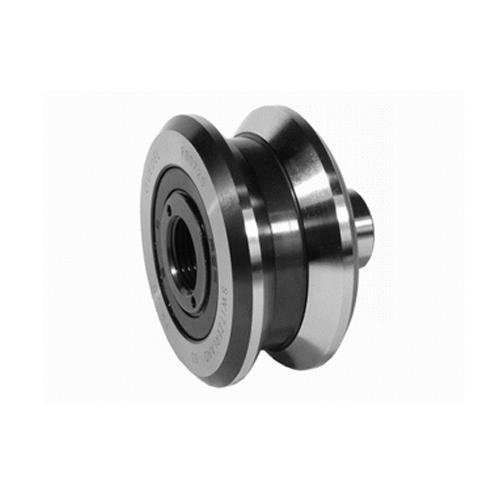
Can track bearings be used in both light-duty and heavy-duty machinery applications?
Yes, track bearings can be used in both light-duty and heavy-duty machinery applications. They are versatile components that offer reliable support for linear motion in a wide range of industrial settings. Here’s a detailed explanation:
1. Light-Duty Machinery Applications:
In light-duty machinery applications, track bearings provide cost-effective and efficient solutions for various tasks. Light-duty track bearings are designed to handle lower loads and are commonly used in applications such as:
- Office automation equipment
- Consumer electronics
- Printing machinery
- Small conveyors and material handling systems
- Automated vending machines
- Textile machinery
These applications typically involve lighter loads and lower operating speeds, making light-duty track bearings suitable for providing smooth and reliable linear motion.
2. Heavy-Duty Machinery Applications:
Track bearings are also widely used in heavy-duty machinery applications that require robust components capable of handling substantial loads and challenging operating conditions. Heavy-duty track bearings are designed to withstand higher loads and offer increased durability. They are commonly employed in applications such as:
- Material handling equipment
- Construction machinery
- Mining equipment
- Transportation systems
- Industrial automation
- Large-scale conveyors
- Steel mills
These applications often involve heavy loads, high operating speeds, and demanding environments. Track bearings in heavy-duty machinery applications are engineered to provide reliable performance, extended service life, and resistance to factors such as contamination, shock, and vibration.
Track bearings are available in various sizes, designs, and load capacities, allowing them to be tailored to the specific requirements of both light-duty and heavy-duty machinery applications. Manufacturers offer a range of options to accommodate different load capacities, operating conditions, and performance specifications.
It is important to consider the specific requirements and operating conditions of the machinery application when selecting track bearings. Consulting with bearing manufacturers or industry experts can help ensure the appropriate track bearings are chosen for optimal performance and reliability in both light-duty and heavy-duty machinery applications.
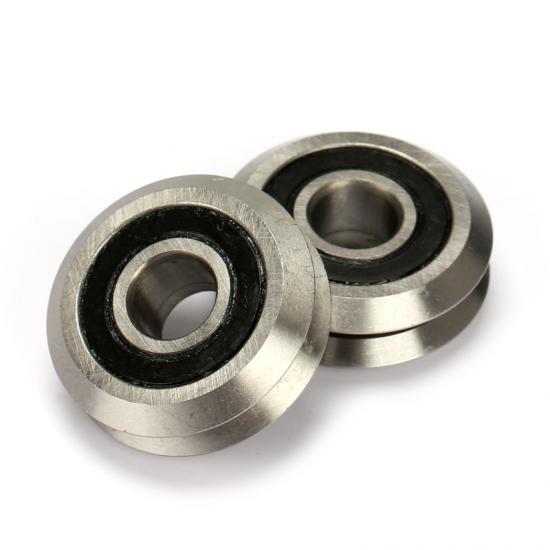
Can you describe the load-carrying capacity and load ratings of track bearings?
Track bearings are designed to withstand and carry various types of loads while maintaining smooth and controlled motion along a track or guide rail. The load-carrying capacity and load ratings of track bearings are crucial factors to consider when selecting the appropriate bearing for a specific application. Let’s delve into these concepts:
Load-Carrying Capacity:
The load-carrying capacity of a track bearing refers to its ability to support and distribute the applied loads without excessive deformation or failure. It is influenced by several factors, including the bearing’s design, materials, and operating conditions. The load-carrying capacity is typically specified in terms of static load capacity and dynamic load capacity.
The static load capacity indicates the maximum load that a track bearing can support without permanent deformation. It is determined by the bearing’s internal geometry, material strength, and the contact area between the rolling elements and raceways. Static loads are those that do not cause relative motion between the bearing and the track, such as when the bearing is stationary or subjected to a constant load.
The dynamic load capacity represents the maximum load that a track bearing can handle while still allowing smooth rolling motion. It takes into account the bearing’s ability to handle both radial and axial loads and considers factors such as the bearing’s internal clearance, lubrication, and operating speed. Dynamic loads are those that cause relative motion between the bearing and the track, such as when the bearing is subjected to varying loads or subjected to motion along the track.
Load Ratings:
Load ratings provide standardized values that indicate the maximum allowable loads for track bearings based on industry standards. These load ratings are commonly provided by bearing manufacturers and help users select the appropriate bearing for their specific application requirements. The two primary load ratings used for track bearings are the radial load rating and the axial load rating.
The radial load rating specifies the maximum radial load that a track bearing can withstand while maintaining proper performance and service life. It is expressed as a static load rating and a dynamic load rating. The static radial load rating indicates the maximum radial load that the bearing can support without permanent deformation, while the dynamic radial load rating represents the maximum radial load that the bearing can handle under typical operating conditions.
The axial load rating indicates the maximum axial load that a track bearing can withstand without excessive deformation or failure. It considers the applied axial force in the direction perpendicular to the track or guide rail. The axial load rating is typically provided as a static load rating and a dynamic load rating.
It’s important to note that load ratings are based on specific operating conditions, such as a certain speed, lubrication, and temperature. It is necessary to consider the actual operating conditions and factors such as shock loads, vibrations, and misalignments when applying load ratings to real-world applications.
By understanding the load-carrying capacity and load ratings of track bearings, engineers and designers can make informed decisions to ensure reliable and safe performance of the bearings in their applications.


editor by CX 2024-04-08